Seit anderthalb Wochen wird es hier an der Uni gestreikt. Oder besser gesagt: demonstriert. Zu meiner großen Erleichterung ging man bisher unbehelligt weiter in den Vorlesungen, auch im Verfügungsgebäude, dessen Erdgeschoß von den Protestierenden besetzt wurde.
Ein komisches Gefühl, zwischen den Protestschilder in das Gebäude zu gehen...Obwohl ich mehr und mehr Verständnis für die Studenten und ihren Unzufriedenheit mit dem Ablauf des Bologna-Reforms habe, bin ich immerhin etwas gespalten. Es ist mir nicht unwichtig, aber ich bin nicht hier gekommen, um mich in deutschen hochschulpolitischen Problemen zu verwickeln. Ich bin hier gekommen, um zu studieren. Und dann trotzdem gezwungen zu fühlen, Partei zu nehmen, wenn es mir letztendlich nicht angeht: Es ist alles etwas unbehaglich.
Heute ging es aber richtig zu: man blockierte das Zentrale Hörsaalgebäude. Ich merke, wie das alles genau erwägt wird. Weil viele großen Vorlesungen dort stattfinden, ist das schon von symbolischer Bedeutung. Und tatsächlich kam es (wenn ich richtig verstanden habe) sogar zu Gespräche mit der Universitätsleitung. Aber gleichzeitig war der Unialltag wenig davon betroffen und die meisten Veranstaltungen fielen nicht aus.
Wenn ich sehe, wie kompliziert und unübersichtlich das neue System ist, und unter wie viel Druck die Studenten leiden, weil die neue Regeln schlecht oder inkonsequent durchgesetzt werden, wundert es mich nicht, dass sie die Situation etwas unbefriedigend finden, oder dass sie ihrem Ärger Luft machen wollen. Man fühlt sich mißhandelt, machtlos. Und irgendwie muss man versuchen, sich damit abzufinden.
Aber ich würde sagen, es ist auch eine Chance. Weil alles schon im Umbruch ist, hat man auch die Möglichkeit, etwas wirklich zu verbessern. Mitzubestimmen. Und die Proteste haben schon für Aufsehen gesorgt. Wenn ich es dann mit dem Zustand in den USA vergleiche, das ist schon etwas, finde ich. Bei uns gibt es einfach keinen Anlass für solche bundesweiten Proteste, obwohl das System unzweifelhaft auch seine Probleme hat. Es ist ironisch vielleicht, dass man ein schlecht durchführtes Reform braucht, um utopistische Visionen wieder zu erwecken.
Mittwoch, 25. November 2009

Sonntag, 15. November 2009
interesting times
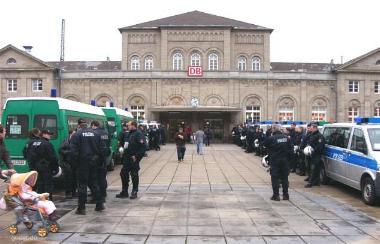
On Saturday a friend and I used our semester train ticket to do some sightseeing in Hannover (about an hour north of Göttingen). When we came back in the early afternoon, we left the train station only to find dozens of police officers lined up in rows on either side of the entrance. It was a surreal moment. (If you remember the scene in "Lola Rennt" with the swat team pointing their guns at Lola as she comes out of the bank -- it felt a little bit like that, I wasn't scared, just puzzled, like I had walked onto a stage in the middle of a performance. Except that it was broad daylight and -- unlike Lola -- I hadn't just robbed a bank.)
My first thought, rather irrelevantly, was that I didn't know there were so many police officers in the entire city. And then the more normal question: Was ist denn hier los?
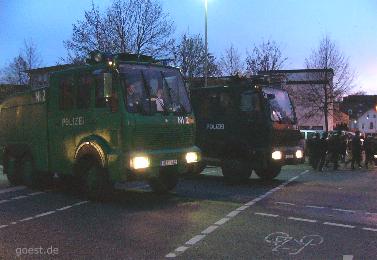
As we walked towards the city center: more police cars, blockaded streets, and the sound of a loudspeaker. Ah, okay. Must be something political then.
Was I supposed to know what this was all about? I thought maybe I had missed something as a result of my usual wandering around obliviously....
It turns out the occasion was the anniversary of the the death of a Göttingen student who was killed at an antifascist protest in 1989. The organizers, fearing, I presume, that their demonstration would be prevented if they announced it officially, did not advertise it beforehand. So in this case my ignorance makes a little bit more sense.
However, I think people active in leftist circles would have been aware of it well in advance. It seems this particular event has become something of a rallying point for groups all over the country: One of my Berlin friends said he had seen leaflets about the demonstration in the Berlin subway that morning!
There is an ironic aspect to this. Some of the posters for the demonstration proclaimed "Kein Frieden mit dem Polizei- und Überwachungsstaat." Rather than opening up space for change, however, the protest only seems to have turned onto a reenactment of the original occasion, turning the city for some hours into precisely that police state it was directed against.
Last week of course was the twentieth anniversary of the fall of the Berlin Wall and the (unofficial) birth of a reunified Germany. Feeling a bit left out and isolated, I had been wishing I were in Berlin, in the middle of things. To be part of all of this, here, no longer looking on from afar, from outside, as I have done for so long, but actually seeing and experiencing some small piece of the history of this country.
It turns out I may be more in the middle of things than I had thought...
My first thought, rather irrelevantly, was that I didn't know there were so many police officers in the entire city. And then the more normal question: Was ist denn hier los?
As we walked towards the city center: more police cars, blockaded streets, and the sound of a loudspeaker. Ah, okay. Must be something political then.
Was I supposed to know what this was all about? I thought maybe I had missed something as a result of my usual wandering around obliviously....
It turns out the occasion was the anniversary of the the death of a Göttingen student who was killed at an antifascist protest in 1989. The organizers, fearing, I presume, that their demonstration would be prevented if they announced it officially, did not advertise it beforehand. So in this case my ignorance makes a little bit more sense.
However, I think people active in leftist circles would have been aware of it well in advance. It seems this particular event has become something of a rallying point for groups all over the country: One of my Berlin friends said he had seen leaflets about the demonstration in the Berlin subway that morning!
There is an ironic aspect to this. Some of the posters for the demonstration proclaimed "Kein Frieden mit dem Polizei- und Überwachungsstaat." Rather than opening up space for change, however, the protest only seems to have turned onto a reenactment of the original occasion, turning the city for some hours into precisely that police state it was directed against.
Last week of course was the twentieth anniversary of the fall of the Berlin Wall and the (unofficial) birth of a reunified Germany. Feeling a bit left out and isolated, I had been wishing I were in Berlin, in the middle of things. To be part of all of this, here, no longer looking on from afar, from outside, as I have done for so long, but actually seeing and experiencing some small piece of the history of this country.
It turns out I may be more in the middle of things than I had thought...
Samstag, 14. November 2009
More Contrastive Focus Reduplication
Als ich gestern frühstücken wollte, waren zwei Mitbewohner bereits in der Küche und diskutierten gerade die Bedeutung des Wort 'satt'. Vorigen Tag nämlich hatte jemand die etwas merkwürdig klingende These geaüßert, daß Kaffee satt macht, und jetzt fragten sie sich, ob man das eigentlich sagen könnte. Gemeint in diesen Fall war nicht, daß man keinen Hunger mehr hatte, sondern keine Durst.
Es scheint wirklich hier ein semantisches Loch zu geben. Für das Gegensatzpaar
'hungrig -- satt'
'durstig -- ???'
gibt es kein entsprechendes Wort für 'nicht mehr durstig'.
Dann kam natürlich die obligatorische Frage, ob es ein englisches Äquivalent für das deutsche Wort 'satt' gibt. Nein, eigentlich nicht so genau, das hat mir auch schon mal gefehlt, obwohl man 'full' oder 'satisfied' sagen kann. Und das gesuchte Wort für 'nicht durstig' haben wir wohl auch nicht. Also auch hier keine Lösung. (Im Nachhinein fällt es mir ein, daß man auf Englisch 'quench one's thirst' sowie auch auf Deutsch 'Durst stillen' sagen kann. Aber gesucht war eigentlich ein brauchbares Adjektiv...)
Ich habe dann gefragt, als Nichtmuttersprachler, ob man unter 'satt' sowohl 'nicht durstig' als auch 'nicht hungrig' verstehen kann. Man kann ja 'satt' im übertragenen Sinn gebrauchen, etwas wie 'keine Lust mehr haben'. Hmm, OK, vielleicht, war die Meinung, aber ich habe das Gefühl gekriegt, auf jeden Fall wäre diese Bedeutung, wenn überhaupt möglich, gar nicht so zentral wie 'keinen Hunger haben'.
Mittlerweile waren ihre Eier fertig, und eine von den Mädels hat beschwert, daß sie schon satt war. Und dann hat sie hinzugefügt: 'satt-satt, nicht kaffee-satt'. Und wir haben alle gelacht.
Also contrastive focus reduplication gibt es doch auf Deutsch.
(Eine interessante Diskussion zum Thema 'nicht durstig' gibt es übrigens hier bei Leo.)
Es scheint wirklich hier ein semantisches Loch zu geben. Für das Gegensatzpaar
'hungrig -- satt'
'durstig -- ???'
gibt es kein entsprechendes Wort für 'nicht mehr durstig'.
Dann kam natürlich die obligatorische Frage, ob es ein englisches Äquivalent für das deutsche Wort 'satt' gibt. Nein, eigentlich nicht so genau, das hat mir auch schon mal gefehlt, obwohl man 'full' oder 'satisfied' sagen kann. Und das gesuchte Wort für 'nicht durstig' haben wir wohl auch nicht. Also auch hier keine Lösung. (Im Nachhinein fällt es mir ein, daß man auf Englisch 'quench one's thirst' sowie auch auf Deutsch 'Durst stillen' sagen kann. Aber gesucht war eigentlich ein brauchbares Adjektiv...)
Ich habe dann gefragt, als Nichtmuttersprachler, ob man unter 'satt' sowohl 'nicht durstig' als auch 'nicht hungrig' verstehen kann. Man kann ja 'satt' im übertragenen Sinn gebrauchen, etwas wie 'keine Lust mehr haben'. Hmm, OK, vielleicht, war die Meinung, aber ich habe das Gefühl gekriegt, auf jeden Fall wäre diese Bedeutung, wenn überhaupt möglich, gar nicht so zentral wie 'keinen Hunger haben'.
Mittlerweile waren ihre Eier fertig, und eine von den Mädels hat beschwert, daß sie schon satt war. Und dann hat sie hinzugefügt: 'satt-satt, nicht kaffee-satt'. Und wir haben alle gelacht.
Also contrastive focus reduplication gibt es doch auf Deutsch.
(Eine interessante Diskussion zum Thema 'nicht durstig' gibt es übrigens hier bei Leo.)
Samstag, 31. Oktober 2009
Kleist in the Theater
I've been trying to take advantage of the rich variety of cultural events the city has to offer -- there are three quite active theaters and frequent readings by both established and less well-known authors -- but mostly I've always been either too stressed or too absent-minded and haven't actually managed to attend anything.
Until this last week, when I saw two productions, both of them based on works by Kleist. (Nearly two centuries after his death, Kleist finally seems to be coming into his own on the German stage. I'm all for it.)
The first was an adaptation of the short story "Die Marquise von O" based on a stage version by Ferdinand Bruckner. The acting was superb, as was the blocking. The music was somewhat odd, but effective. The piece shifts the emphasis of the story somewhat: while much of Kleist's story depends on the fact that the reader is as much in the dark as the characters, the play leaves no doubt about what happened to the Marquise and who is responsible for her pregnancy. Instead, it focuses on the aftermath of rape and the victim's difficulty in coming to terms with what happened (to the point of denying or repressing the traumatic event) and her contradictory feelings about her rapist.
Thus, the adaptation was based on the insight that at the core of the story is a psychological dilemma which is still very relevant today. Oddly enough, this was the main weakness of the production as well as its strength.
Interspersed between the scenes were recitations by a narrator of passages from the story; in some ways this is quite a brilliant idea, it's imminently appropriate for Kleist where problems of knowledge have such a central role. Particularly when the narrator is present as an observer at key scenes and later slips into the role of one of the characters.
However, as actually used in the production, the narration was jarring and sometimes quite confusing. Rather than providing key bits of information which the characters were unaware of or unable to admit, or (more prosaicly) filling in gaps in time, the narration summarized portions of the story which were subsequently acted out by the other characters.
Because the outlines of the story were the same, but the responses of the characters to the various events were not, the narration created a sense of dissonance, emphasizing the differences between Kleist's society and our modern, liberated one, as though the play were engaged in a dispute with its classical model. And this, in turn, tended to reduce the plausibility of the modern version. The characters' behavior within the individual scenes made sense, but the scenes themselves didn't always seem to completely fit together, except by the (externally imposed) structure of Kleist's story. So, while the idea is interesting, in this case I think in practice it fell somewhat short of its goal.
The second piece was "Das Kätchen von Heilbronn". I think it would have helped if I had been acquainted with more than the general outline of the play before seeing it, both from the standpoint of simply understanding what was going on, as well as being able to recognize where the director had taken liberties with the script and where, in fact, he hadn't.
This was...an unusual and sometimes rather disorienting experience. Quite literally: the audience sat on the stage while the action took place backstage, in the wings, the rafters, and even the seating area normally reserved for the audience. It is extremely odd to sit in the dark at the beginning of the play facing the wrong side of the curtain. And then to have the whole podium on which you are sitting suddenly start rotating to reveal a whole new space in the area that had been behind you. And so the play opens to a surreal trial instigated by some unknown entity (God?) while the chararacters try to explain themselves to voices coming from above in the catwalk. (When I describe it this way one wants to ask, is this Kleist we're talking about here or some modern absurdist play? Lest anyone get the wrong impression: this was not a misguided attempt to 'modernize' a classic, although it did make use of a wide variety of styles and media. Let us say rather that Kleist's concern with existential crises, the difficulty his characters have in distinguishing dream from reality -- these elements of his work find a certain sympathy in contemporary audiences. So the comparison with the theater of the absurd is perhaps not as unapt as it seems at first glance.)
The rotating stage was more effective at the beginning, where the audience was still not entirely sure what to expect. By the sixth or seventh rotation, however, the suspicion began to creep in that these shifts were motivated less by dramatic or artistic reasons than because the script required a change of scene. All the same -- on some level it remained impressive. Along with the film projections onto the stage, the special effects (rain and wind), and the suspension of several characters on cables, it rather took on the quality of a grandious spectacle.
The slightly fantastic feel, the constant running about and mixture of styles and periods seems appropriate, however, for a play which I suspect is fairly chaotic (Shakespearean, I suppose it would have been described in Kleist's day). I'm not absolutely certain that the angel who appeared in the piece, and who played the role of companion, helper, and sometimes not-so-subtle manager of the unfolding events was part of the original, but I wouldn't put it past Kleist, either.
I really need to go back and read the play, now. Although one of the nice things about theater is that (most of the time) you don't need to understand every word to be able to follow the general flow of the plot, all the same, the performance was a sobering reminder of where the limits of my German skills are. Understanding a lecture, where the primary goal is to communicate information, is one thing; processing Kleist's archaic language while it is spoken by agitated characters is another. And I'm definitely not quite there yet.
"Die Marquise von O." Ferdinand Bruckner/Heinrich von Kleist. Directed by Alexander Krebs. Junges Theater, Göttingen. 28.10.09
"Das Käthchen von Heilbronn." Heinrich von Kleist. Directed by Mark Zurmühle. Deutsches Theater, Göttingen. 30. 10.09
Until this last week, when I saw two productions, both of them based on works by Kleist. (Nearly two centuries after his death, Kleist finally seems to be coming into his own on the German stage. I'm all for it.)
The first was an adaptation of the short story "Die Marquise von O" based on a stage version by Ferdinand Bruckner. The acting was superb, as was the blocking. The music was somewhat odd, but effective. The piece shifts the emphasis of the story somewhat: while much of Kleist's story depends on the fact that the reader is as much in the dark as the characters, the play leaves no doubt about what happened to the Marquise and who is responsible for her pregnancy. Instead, it focuses on the aftermath of rape and the victim's difficulty in coming to terms with what happened (to the point of denying or repressing the traumatic event) and her contradictory feelings about her rapist.
Thus, the adaptation was based on the insight that at the core of the story is a psychological dilemma which is still very relevant today. Oddly enough, this was the main weakness of the production as well as its strength.
Interspersed between the scenes were recitations by a narrator of passages from the story; in some ways this is quite a brilliant idea, it's imminently appropriate for Kleist where problems of knowledge have such a central role. Particularly when the narrator is present as an observer at key scenes and later slips into the role of one of the characters.
However, as actually used in the production, the narration was jarring and sometimes quite confusing. Rather than providing key bits of information which the characters were unaware of or unable to admit, or (more prosaicly) filling in gaps in time, the narration summarized portions of the story which were subsequently acted out by the other characters.
Because the outlines of the story were the same, but the responses of the characters to the various events were not, the narration created a sense of dissonance, emphasizing the differences between Kleist's society and our modern, liberated one, as though the play were engaged in a dispute with its classical model. And this, in turn, tended to reduce the plausibility of the modern version. The characters' behavior within the individual scenes made sense, but the scenes themselves didn't always seem to completely fit together, except by the (externally imposed) structure of Kleist's story. So, while the idea is interesting, in this case I think in practice it fell somewhat short of its goal.
The second piece was "Das Kätchen von Heilbronn". I think it would have helped if I had been acquainted with more than the general outline of the play before seeing it, both from the standpoint of simply understanding what was going on, as well as being able to recognize where the director had taken liberties with the script and where, in fact, he hadn't.
This was...an unusual and sometimes rather disorienting experience. Quite literally: the audience sat on the stage while the action took place backstage, in the wings, the rafters, and even the seating area normally reserved for the audience. It is extremely odd to sit in the dark at the beginning of the play facing the wrong side of the curtain. And then to have the whole podium on which you are sitting suddenly start rotating to reveal a whole new space in the area that had been behind you. And so the play opens to a surreal trial instigated by some unknown entity (God?) while the chararacters try to explain themselves to voices coming from above in the catwalk. (When I describe it this way one wants to ask, is this Kleist we're talking about here or some modern absurdist play? Lest anyone get the wrong impression: this was not a misguided attempt to 'modernize' a classic, although it did make use of a wide variety of styles and media. Let us say rather that Kleist's concern with existential crises, the difficulty his characters have in distinguishing dream from reality -- these elements of his work find a certain sympathy in contemporary audiences. So the comparison with the theater of the absurd is perhaps not as unapt as it seems at first glance.)
The rotating stage was more effective at the beginning, where the audience was still not entirely sure what to expect. By the sixth or seventh rotation, however, the suspicion began to creep in that these shifts were motivated less by dramatic or artistic reasons than because the script required a change of scene. All the same -- on some level it remained impressive. Along with the film projections onto the stage, the special effects (rain and wind), and the suspension of several characters on cables, it rather took on the quality of a grandious spectacle.
The slightly fantastic feel, the constant running about and mixture of styles and periods seems appropriate, however, for a play which I suspect is fairly chaotic (Shakespearean, I suppose it would have been described in Kleist's day). I'm not absolutely certain that the angel who appeared in the piece, and who played the role of companion, helper, and sometimes not-so-subtle manager of the unfolding events was part of the original, but I wouldn't put it past Kleist, either.
I really need to go back and read the play, now. Although one of the nice things about theater is that (most of the time) you don't need to understand every word to be able to follow the general flow of the plot, all the same, the performance was a sobering reminder of where the limits of my German skills are. Understanding a lecture, where the primary goal is to communicate information, is one thing; processing Kleist's archaic language while it is spoken by agitated characters is another. And I'm definitely not quite there yet.
"Die Marquise von O." Ferdinand Bruckner/Heinrich von Kleist. Directed by Alexander Krebs. Junges Theater, Göttingen. 28.10.09
"Das Käthchen von Heilbronn." Heinrich von Kleist. Directed by Mark Zurmühle. Deutsches Theater, Göttingen. 30. 10.09
Montag, 19. Oktober 2009
Inventory
"Die Stadt Göttingen, berühmt durch ihre Würste und Universität, gehört dem Könige von Hannover, und enthält 999 Feuerstellen, diverse Kirchen, eine Entbindungsanstalt, eine Sternwarte, einen Karzer, eine Bibliothek und einen Ratskeller, wo das Bier sehr gut ist."
("The city of Göttingen, renowned for its sausages and its university, belongs to the king of Hannover and contains 999 fireplaces, diverse churches, one maternity ward, one observatory, one prison, one library, and one town hall cellar, where the beer is quite good.")
-Heinrich Heine, Die Harzreise
My inventory is certainly less extensive than Heine's, and as yet I can't say much about the quality of the beer or sausage, but during my wanderings over the last couple of weeks in the Innenstadt (old city center), I was pleased to discover almost immediately no less than four used book stores. And they seem to have normal hours, unlike the ones in Berlin, most of which seem to be open about three days a week at random times. However, except for the one which is located along the main street, I'm not at all certain that I will be able to find any of them again, because I always seem to get lost in the Innenstadt and I stumbled across most of the used book stores serendipitiously when I had no idea where I was. In addition, I've found at least three tea shops, numerous döner stands, and just about anything else one might need (you know, mundane details like clothes and dishes and shampoo). But as yet no fabric store.
I'm gradually starting to be able to find my way around the uni. The library is beautiful, the student center is crowded. What I miss so far are the random places to curl up and read or study. Most of the library (i.e. the part with the books) is off limits unless you first check your coat and bags. So, there are places to study, but given the casual atmosphere that I'm used to at Norlin, I'm not quite comfortable with this system yet. I imagine within a few months it will start to seem routine.
Classes started last Monday, and everything seemed to fall into place. I'm still very confused about a lot of the details -- what we're doing is the same, but how it's organized is definitely not -- but it's good to be back at work and doing what I came here for! The familiarity is reassuring. I think as far as the university stuff is concerned, I'll be all right, I have the necessary knowledge and techne.
What I lack, however, is everyday experience. Things like: at which stores do I buy what (not always quite as simple as it sounds), how much does (for example) a case of eggs usually cost, what is open on a Sunday and how late, and where does one start when one is looking for, say, a used bicycle? All of a sudden my research skills and my intuitive knowledge about how things are done at home don't help anymore. Some of this stuff I can ask about, the rest I'll probably have to figure out by trial and error. But that's what I'm here for. The everyday stuff, not just the academic experience.
("The city of Göttingen, renowned for its sausages and its university, belongs to the king of Hannover and contains 999 fireplaces, diverse churches, one maternity ward, one observatory, one prison, one library, and one town hall cellar, where the beer is quite good.")
-Heinrich Heine, Die Harzreise
My inventory is certainly less extensive than Heine's, and as yet I can't say much about the quality of the beer or sausage, but during my wanderings over the last couple of weeks in the Innenstadt (old city center), I was pleased to discover almost immediately no less than four used book stores. And they seem to have normal hours, unlike the ones in Berlin, most of which seem to be open about three days a week at random times. However, except for the one which is located along the main street, I'm not at all certain that I will be able to find any of them again, because I always seem to get lost in the Innenstadt and I stumbled across most of the used book stores serendipitiously when I had no idea where I was. In addition, I've found at least three tea shops, numerous döner stands, and just about anything else one might need (you know, mundane details like clothes and dishes and shampoo). But as yet no fabric store.
I'm gradually starting to be able to find my way around the uni. The library is beautiful, the student center is crowded. What I miss so far are the random places to curl up and read or study. Most of the library (i.e. the part with the books) is off limits unless you first check your coat and bags. So, there are places to study, but given the casual atmosphere that I'm used to at Norlin, I'm not quite comfortable with this system yet. I imagine within a few months it will start to seem routine.
Classes started last Monday, and everything seemed to fall into place. I'm still very confused about a lot of the details -- what we're doing is the same, but how it's organized is definitely not -- but it's good to be back at work and doing what I came here for! The familiarity is reassuring. I think as far as the university stuff is concerned, I'll be all right, I have the necessary knowledge and techne.
What I lack, however, is everyday experience. Things like: at which stores do I buy what (not always quite as simple as it sounds), how much does (for example) a case of eggs usually cost, what is open on a Sunday and how late, and where does one start when one is looking for, say, a used bicycle? All of a sudden my research skills and my intuitive knowledge about how things are done at home don't help anymore. Some of this stuff I can ask about, the rest I'll probably have to figure out by trial and error. But that's what I'm here for. The everyday stuff, not just the academic experience.
'Woher kommst du?'
[On politeness forms and having an American accent]
Es ist ein prekäres Gleichgewicht.
Ich bin daran gewöhnt: sobald man erfährt, daß ich Amerikanerin bin, reden alle plötzlich auf Englisch. Also warte ich immer mit einer gewisser Spannung darauf, bis es geschieht. Dann etwas wie Erleichterung, wenn es doch anders kommt.
Und meistens spricht man tatsächlich Deutsch mit mir, sogar manchmal, wenn ich es nicht unbedingt erwartet hätte. Wie dankbar ich war, als der Mann bei der Sicherheitskontrolle am Flughafen in Zürich mich höflich fragte 'Verstehen Sie Deutsch?' weil ich verwirrt herumschaute. Dankbar, daß man mir die Chance gab, meine Sprachkenntnisse zu beweisen.
Und dann im Antiquariat, als ich ein Reclam Ausgabe und ein Roman von Christa Wolf kaufte, ein Paar Sätze auf Englisch, und die Frage: 'Kommst du aus England?'
'Nein, aus den USA.'
Die Welt wurde plötzlich gebrechlich.
Nicht, daß ich dachte, er wechselte nach Englisch weil er es mir nicht zutraute, Deutsch zu reden. Es ging nicht darum. Es war eher wie seine Frage: er wollte mich zeigen, daß er meinen Akzent erkannt hatte, daß er etwas über mich wußte.
Nur, es tat weh. Wegen meines Akzents. Als ob ich durchsichtig geworden wäre, damit man in mich hineinsehen könnte.
Und er hat geduzt.
Ich glaube, das hat mich auch ein bißchen verletzt.
Ich weiß, daß es in Deutschland mittlerweile etwas geändert hat, man duzt häufiger als vorher. Aber in einem Laden? Da bleibt man auf 'Sie', oder?
Weil es für mich nicht selbstverständlich ist, weil ich mich bemühen muss, das richtige Pronomen anzuwenden, ist es auch unheimlich wichtig: ein Zeichen, daß ich Erwachsen bin, daß man mich ernst nimmt. Daß ich akzeptiert bin, mitwirken kann. Auch als Ausländer.
Die Leiterin des Studium International hat mich auch geduzt. Ich glaube, es war freundlich gemeint, sie machte Sorgen um mich, wollte mich beruhigen.
Ich glaube, mir wäre es angenehmer, wenn sie gesiezt hätte.
Normalerweise bin ich gegenüber solchen Sachen nicht so empfindlich, auch wenn ich selbst oft formaler Anredeformen benutze, als gewöhnlich wäre. Aber es hat mich gestört.
Eine Anekdote von einem ungarischen Skandinavisten, der in Norwegen war, wo es zwei Standardschriftarten und viele mündliche Dialekte gibt: Er wurde gefragt, 'woher kommst du, welchen Dialekt sprichst du denn, ich kenne es nicht.'
Naja, so geht es auch.
Es ist ein prekäres Gleichgewicht.
Ich bin daran gewöhnt: sobald man erfährt, daß ich Amerikanerin bin, reden alle plötzlich auf Englisch. Also warte ich immer mit einer gewisser Spannung darauf, bis es geschieht. Dann etwas wie Erleichterung, wenn es doch anders kommt.
Und meistens spricht man tatsächlich Deutsch mit mir, sogar manchmal, wenn ich es nicht unbedingt erwartet hätte. Wie dankbar ich war, als der Mann bei der Sicherheitskontrolle am Flughafen in Zürich mich höflich fragte 'Verstehen Sie Deutsch?' weil ich verwirrt herumschaute. Dankbar, daß man mir die Chance gab, meine Sprachkenntnisse zu beweisen.
Und dann im Antiquariat, als ich ein Reclam Ausgabe und ein Roman von Christa Wolf kaufte, ein Paar Sätze auf Englisch, und die Frage: 'Kommst du aus England?'
'Nein, aus den USA.'
Die Welt wurde plötzlich gebrechlich.
Nicht, daß ich dachte, er wechselte nach Englisch weil er es mir nicht zutraute, Deutsch zu reden. Es ging nicht darum. Es war eher wie seine Frage: er wollte mich zeigen, daß er meinen Akzent erkannt hatte, daß er etwas über mich wußte.
Nur, es tat weh. Wegen meines Akzents. Als ob ich durchsichtig geworden wäre, damit man in mich hineinsehen könnte.
Und er hat geduzt.
Ich glaube, das hat mich auch ein bißchen verletzt.
Ich weiß, daß es in Deutschland mittlerweile etwas geändert hat, man duzt häufiger als vorher. Aber in einem Laden? Da bleibt man auf 'Sie', oder?
Weil es für mich nicht selbstverständlich ist, weil ich mich bemühen muss, das richtige Pronomen anzuwenden, ist es auch unheimlich wichtig: ein Zeichen, daß ich Erwachsen bin, daß man mich ernst nimmt. Daß ich akzeptiert bin, mitwirken kann. Auch als Ausländer.
Die Leiterin des Studium International hat mich auch geduzt. Ich glaube, es war freundlich gemeint, sie machte Sorgen um mich, wollte mich beruhigen.
Ich glaube, mir wäre es angenehmer, wenn sie gesiezt hätte.
Normalerweise bin ich gegenüber solchen Sachen nicht so empfindlich, auch wenn ich selbst oft formaler Anredeformen benutze, als gewöhnlich wäre. Aber es hat mich gestört.
Eine Anekdote von einem ungarischen Skandinavisten, der in Norwegen war, wo es zwei Standardschriftarten und viele mündliche Dialekte gibt: Er wurde gefragt, 'woher kommst du, welchen Dialekt sprichst du denn, ich kenne es nicht.'
Naja, so geht es auch.
Donnerstag, 8. Oktober 2009
Kreislauf
[In which I complain about German bureaucracies]
Das nächste mal, das jemand mir etwas über 'German efficiency' sagt, würde ich ihn bitten, mal in irgendeiner Behörde zu gehen, um etwas zu erledigen. Um ganz gerecht zu sein, wenn man das richtige Amt gefunden hat, sind die Beamte alle sehr höflich und kompetent, wissen genau, was sie von einem brauchen, und machen überhaupt keinen Ärger, was ich jedenfalls über die amerikanischen Bureaukraten nicht sagen könnte. Aber natürlich muss man erst mal wissen, wo man hin muss, und das ist gar nicht so einfach.
Ich hab die letzten drei Tage nur mit dem Versuch verbracht, die richtige Unterlagen zu bekommen und die dann an die richtigen Stellen abzuliefern. Erstmal einen Krankenversicherung bekommen. Aber dafür braucht man den Kontonummer, und das dauert noch einige Tage, bis der Konto läuft. Also dann nochmal bei der Krankenkasse melden. Dann wieder nach oben zur Wohnheimverwaltung. Die brauchen wiederum eine Bestätigung von der Einwohnermeldeamt. Und so weiter.
Wäre alles nicht so schlimm, aber die Stadtmitte, wo die Ämter sind, ist etwa 20-30 Minuten zu Fuß (abhängig davon, wie müde ich bin) von der Wohnung entfernt, und ich glaube, ich habe diese Strecke schon wenigstens acht mal gelaufen. Die Uni selbst kenne ich noch kaum, wohl aber die Strassen zwischen hier und dem Stadtzentrum.
Dazu ist es natürlich unmöglich, alles im voraus zu planen, um möglichst viel herumlaufen zu vermeiden, da die Ämter haben z.B. nur von 10:00-12:00 oder 13:00-15:30 Uhr offen, und wenn man erst spät nachmittags erfährt, dortdrüben muss etwas abgegeben werden, da bleibt nichts übrig, als bis morgen zu warten und wieder dahin zu laufen.
Und inzwischen muss man auch hin und wieder essen, was noch andere Schwierigkeiten bereitet. Da ich tagsüber unterwegs bin, müsste ich immer irgendwo etwas zum Essen kaufen, und das fällt mir immer schwer, aber besonders jetzt, wenn ich schon gestresst bin. Ich kann nämlich nicht essen (oder nicht, auf jeden Fall 'in public') wenn ich ängstlich oder nervös bin. Am liebsten würde ich alleine bei sich mit ein Bisschen Brot und Tee mich hinsetzen, aber in einer neuer Wohnung...mit gemeinsamer Küche...mit wenig Vorrat im Keller...ist es auch nicht so einfach. Ich muss mich wirklich bemühen, dass ich in den nächsten Tagen nicht verhungere, danach ist wahrscheinlich das schlimmste vorbei.
Das nächste mal, das jemand mir etwas über 'German efficiency' sagt, würde ich ihn bitten, mal in irgendeiner Behörde zu gehen, um etwas zu erledigen. Um ganz gerecht zu sein, wenn man das richtige Amt gefunden hat, sind die Beamte alle sehr höflich und kompetent, wissen genau, was sie von einem brauchen, und machen überhaupt keinen Ärger, was ich jedenfalls über die amerikanischen Bureaukraten nicht sagen könnte. Aber natürlich muss man erst mal wissen, wo man hin muss, und das ist gar nicht so einfach.
Ich hab die letzten drei Tage nur mit dem Versuch verbracht, die richtige Unterlagen zu bekommen und die dann an die richtigen Stellen abzuliefern. Erstmal einen Krankenversicherung bekommen. Aber dafür braucht man den Kontonummer, und das dauert noch einige Tage, bis der Konto läuft. Also dann nochmal bei der Krankenkasse melden. Dann wieder nach oben zur Wohnheimverwaltung. Die brauchen wiederum eine Bestätigung von der Einwohnermeldeamt. Und so weiter.
Wäre alles nicht so schlimm, aber die Stadtmitte, wo die Ämter sind, ist etwa 20-30 Minuten zu Fuß (abhängig davon, wie müde ich bin) von der Wohnung entfernt, und ich glaube, ich habe diese Strecke schon wenigstens acht mal gelaufen. Die Uni selbst kenne ich noch kaum, wohl aber die Strassen zwischen hier und dem Stadtzentrum.
Dazu ist es natürlich unmöglich, alles im voraus zu planen, um möglichst viel herumlaufen zu vermeiden, da die Ämter haben z.B. nur von 10:00-12:00 oder 13:00-15:30 Uhr offen, und wenn man erst spät nachmittags erfährt, dortdrüben muss etwas abgegeben werden, da bleibt nichts übrig, als bis morgen zu warten und wieder dahin zu laufen.
Und inzwischen muss man auch hin und wieder essen, was noch andere Schwierigkeiten bereitet. Da ich tagsüber unterwegs bin, müsste ich immer irgendwo etwas zum Essen kaufen, und das fällt mir immer schwer, aber besonders jetzt, wenn ich schon gestresst bin. Ich kann nämlich nicht essen (oder nicht, auf jeden Fall 'in public') wenn ich ängstlich oder nervös bin. Am liebsten würde ich alleine bei sich mit ein Bisschen Brot und Tee mich hinsetzen, aber in einer neuer Wohnung...mit gemeinsamer Küche...mit wenig Vorrat im Keller...ist es auch nicht so einfach. Ich muss mich wirklich bemühen, dass ich in den nächsten Tagen nicht verhungere, danach ist wahrscheinlich das schlimmste vorbei.
Abonnieren
Posts (Atom)